

Why grasses deserve equal billing
Most of us plant a meadow for the flowers, then wonder why the ox-eye daisies flop and the whole thing turns into a scruffy patch of coarse grass. The grasses are the architecture. They hold the flowers upright, fill the gaps between flowering peaks, and provide the tussocks and seed heads that insects and birds depend on long after the last flower has gone over. In a small garden this matters even more, because every square metre has to work harder. Get the grass layer right and the flowers largely look after themselves.
The best native grasses for a compact plot
Aim for a mix of three or four species rather than a single grass. Fine-leaved, slower-growing types suit small beds; the thugs of the meadow world — meadow foxtail, Yorkshire fog, cock's-foot — will swamp a border within two seasons. Good choices include:
- Sheep's fescue (Festuca ovina) — a tight, blue-green tuft that stays low and never flops. Excellent at the front of a bed and happy on thin, dry soil.
- Crested dogstail (Cynosurus cristatus) — neat and compact, with distinctive one-sided seed heads. Slow to spread and tolerant of close mowing, so it copes with a small plot that needs tidy edges.
- Sweet vernal grass (Anthoxanthum odoratum) — the one that gives hay its scent of new-mown summer. Early to flower, which extends the meadow's interest into May.
- Quaking grass (Briza media) — dangling, rattling seed heads that catch the light and hold their shape into winter. A small grass with real presence.
- Common bent (Agrostis capillaris) — a fine, soft-leaved filler that knits the mix together without dominating it.
If your soil is heavy and fertile, add yellow rattle (Rhinanthus minor) to the mix. It is a semi-parasite on grass roots, and it does more to keep a small meadow open and flower-rich than any amount of mowing.
Combining grasses with colourful flowers
Aim for roughly 70 per cent grass to 30 per cent flowers by weight of seed, or about 1–2 g of seed per square metre. That sounds sparse, but grasses tiller outwards and flowers self-sow readily once the sward opens up.
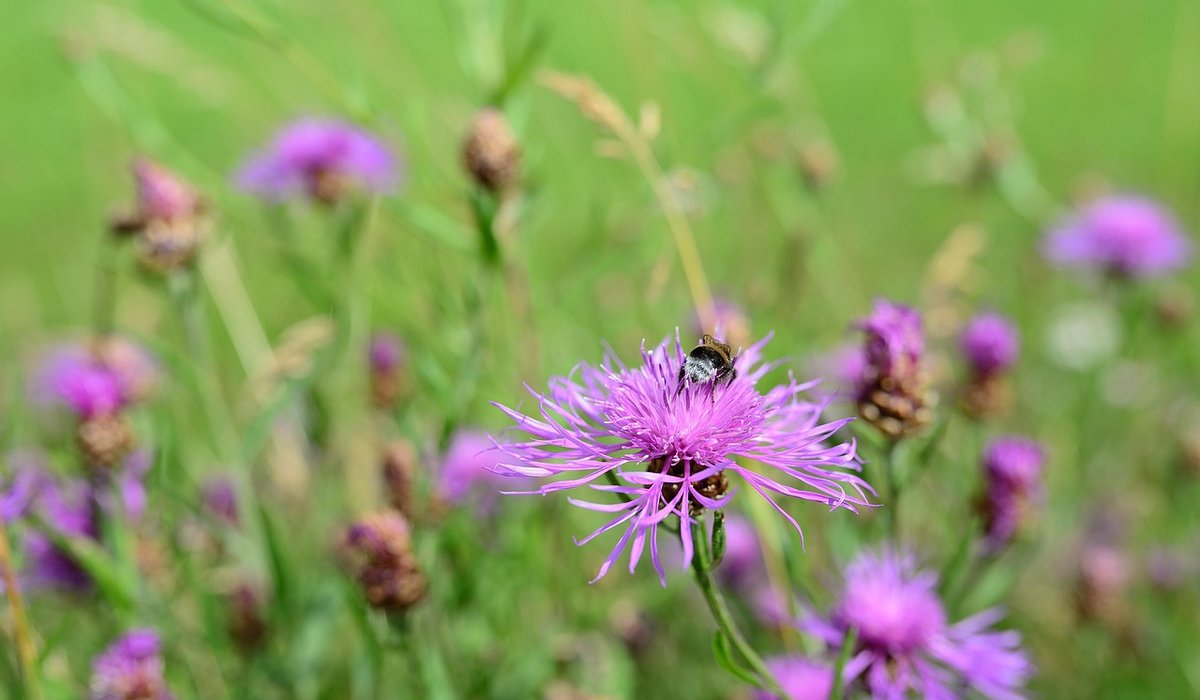
Choose flowers that bloom at different heights and times so something is always in colour. Ox-eye daisy and meadow buttercup bring early white and gold; common knapweed and field scabious carry purple through midsummer; bird's-foot trefoil and selfheal fill the gaps at ankle height. Add cowslip for spring and salad burnet for its russet seed heads in autumn. Tall flowers look best rising through shorter grasses, so keep sheep's fescue and crested dogstail near the front, and let sweet vernal grass and quaking grass sit behind them.
Making a small space feel generous
Don't try to recreate a hay meadow in a bed 3 m by 2 m. Treat it instead as a border with a meadow character. Give it a firm edge — a mowing strip of 20–30 cm keeps the planting looking deliberate rather than neglected. Repeat two or three grass species throughout to create rhythm, and let one reliable flower, such as knapweed, appear at intervals along the bed. If you are converting lawn, strip the turf or smother it for a season before sowing; sowing into existing grass rarely works without yellow rattle and a great deal of patience. Autumn sowing gives roots a head start before the following summer's heat, and sowing into poor, unimproved soil is an advantage rather than a problem.
Managing the meadow through the year
Cutting is the whole art of it. Take the main cut in late July or early August, once the grasses have set seed and most flowers have finished. Cut to about 5–10 cm and, crucially, remove the clippings — leaving them behind enriches the soil and the grasses will romp away with the extra nutrients.
- Late July to August: main cut, with all clippings raked off.
- September to October: a second cut if growth is strong, again clearing the debris.
- October to February: leave it long and untouched. Seed heads stand, tussocks stay intact, and the bed looks good in frost.
- March: a low cut to tidy before new growth, then stand back until the flowers begin.
On richer ground, an extra cut in late spring will check the grasses and give small, slower flowers their chance.
A mix that feeds insects all year
The value of a meadow lies in its continuity. Early flowers such as cowslip, alongside early grasses, feed newly emerged bees; midsummer knapweed, scabious and ox-eye daisy draw bumblebees, hoverflies and butterflies, including meadow browns and ringlets. The grasses themselves are caterpillar food plants, and dense tussocks shelter overwintering ladybirds, beetles and froglets. Leave the seed heads standing and you will also see goldfinches and sparrows working through them in January, when there is precious little else on offer. A balanced mix of native grasses and flowers is not simply prettier; it keeps a small garden working for wildlife right through the year.


Coding is used in almost all aspects of life and work now, be it directly or indirectly. It’s not just for companies in the tech sector. “An increasing number of businesses rely on computer code,
Coding is used in almost all aspects of life and work now, be it directly or indirectly. It’s not just for companies in the tech sector. “An increasing number of businesses rely on computer code,
Coding is used in almost all aspects of life and work now, be it directly or indirectly. It’s not just for companies in the tech sector. “An increasing number of businesses rely on computer code,